
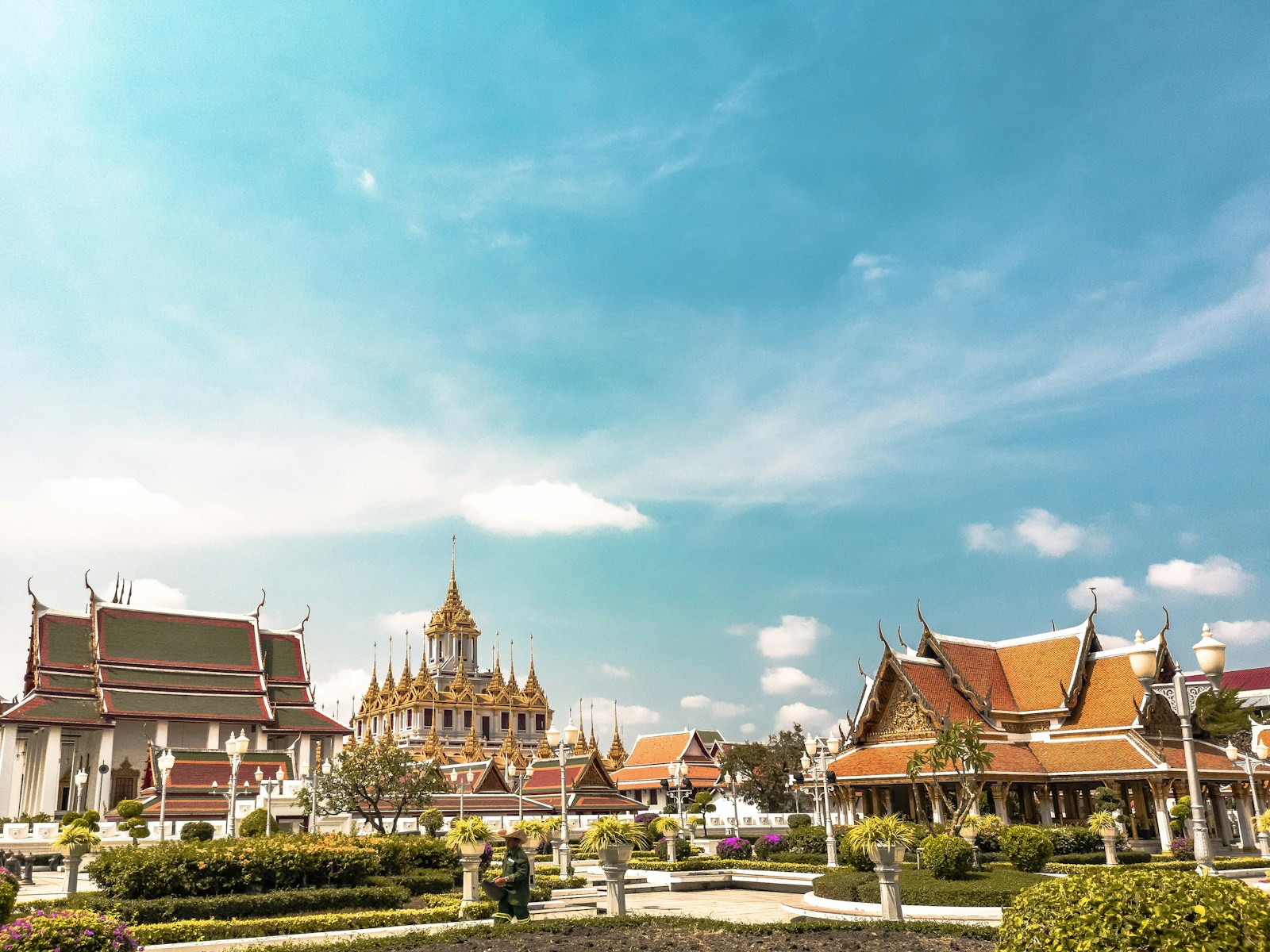
Grand Palace
Bangkok's Royal Heart
The Grand Palace is the single most visited sight in Bangkok and the ceremonial heart of the Thai kingdom. Behind its long white crenellated walls lies a dense compound of throne halls, golden chedis and pavilions built around Wat Phra Kaew, the Temple of the Emerald Buddha — the most sacred Buddhist site in the country. For roughly 150 years this was the official residence of the kings of Siam, and although the royal family now lives elsewhere, the palace is still used for coronations, state ceremonies and royal funerals. The overall effect is deliberately overwhelming: gold leaf, coloured-glass mosaic and mirrored spires catching the tropical sun, mythological guardians several metres tall, and a kilometre-long mural telling Thailand's national epic. It is grand in every sense, and worth arriving early to take in slowly.
A Short History
The palace dates to 1782, when King Rama I, founder of the Chakri dynasty, moved the Siamese capital across the river from Thonburi to Bangkok and laid out a new royal city on Rattanakosin island. He built the palace and its temple to house the Emerald Buddha, a revered jade image only about 66 centimetres tall that had travelled through Laos and northern Thailand before arriving here. Successive kings each added throne halls and pavilions in their own style, which is why the compound mixes traditional Thai roofs with — in the case of the Chakri Maha Prasat — an Italianate building topped by Thai spires, sometimes described as a Thai dancer wearing a European hat. The royal residence shifted to Dusit and later Chitralada Palace in the early twentieth century, leaving the Grand Palace as the kingdom's ceremonial stage.
What to See Inside
The spiritual centrepiece is the Emerald Buddha, seated high on a gilded altar inside its ordination hall; the reigning king ceremonially changes its golden robes three times a year to match the seasons. Around the temple courtyard, look for the Phra Si Rattana Chedi, a brilliant gold stupa said to enshrine a relic of the Buddha; the model of Angkor Wat commissioned by Rama IV; and the towering yaksha demon guardians from the Ramakien. The cloister walls carry a continuous mural of the Ramakien, Thailand's version of the Ramayana, painted in vivid detail. Beyond the temple wall, the palace proper holds the Chakri Maha Prasat and the elegant Dusit Throne Hall. Photography is welcome in the open courtyards but not inside the ordination hall, where you should sit with your feet tucked away from the Buddha image.
Getting There, Tickets and the Dress Code
The palace sits in Rattanakosin beside the river. The easiest approach is the Chao Phraya Express Boat to Tha Chang pier, a few minutes' walk from the entrance; by metro, MRT Sanam Chai is about a 15-minute walk away, and Grab or a metered taxi works from anywhere in the city. Admission for international visitors is around US$15 (500 baht) and includes Wat Phra Kaew and the palace grounds. It is generally open daily from about 08:30 to 15:30, with last entry well before closing. The dress code is strict and enforced: shoulders and knees must be covered, with no sleeveless tops, ripped jeans, short skirts or see-through fabric; a booth near the gate lends suitable clothing against a refundable deposit if needed. Allow two to three hours, and bring water and a hat — there is little shade.
Best Time to Visit and Avoiding the Scams
Come early, ideally right at the 08:30 opening, before the tour buses arrive and the heat builds — the white courtyards offer almost no shade by midday. Late afternoon, an hour or so before closing, is the second-best window. One thing every visitor should know: the area is a hotspot for the 'the palace is closed today' scam. A friendly stranger or a tuk-tuk driver near the gate will claim the palace is shut for a holiday, a ceremony or prayers, and offer a cheap tour of 'special' temples that ends at a gem or tailor shop paying them commission. The Grand Palace is open during its normal hours every day — walk to the official ticket office and check for yourself. After your visit, Wat Pho and its Reclining Buddha are a five-minute walk south, and the ferry to Wat Arun leaves from beside it.
At a Glance
Entry fee
~US$15 (500 THB, foreign visitors)
Opening hours
~8:30am–3:30pm daily
Time needed
2–3 hours
Dress code
Shoulders & knees covered (enforced)
Getting there
Express boat to Tha Chang pier
Best time
Right at 8:30am opening
Highlight
Wat Phra Kaew & the Emerald Buddha